

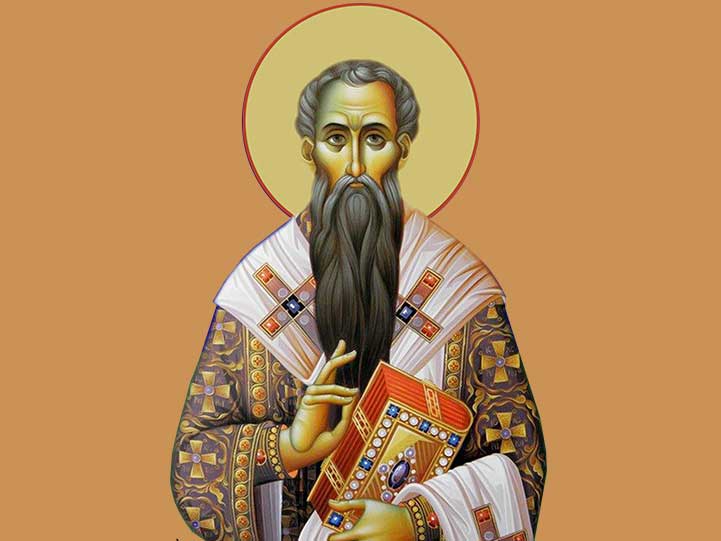
Saint Basil, also known as Basil the Great and Basil of Caesarea, was a bishop of Caesarea in central Asia Minor who staunchly defended the church against the 4th-century CE heresy of Arianism. Basil’s writings on monasticism and theological issues would be hugely influential during his lifetime and in later centuries as the Christian Church developed in the east. The saint, regarded as one of the founders of the Greek Orthodox Church, was also noted for his work helping the poor and his sermons which addressed the imbalances in society.
St. Basil the Great, Latin Basilius
(c. 330 – c. 379 CE)
Easy Life
Basil was born c. 330 CE into an aristocratic family who had a large estate at Ibora on the Pontic-Cappadocian border. He received a thorough education at Nicomedia in Bithynia, northwest Asia Minor, possibly under the tutorship of the famed rhetorician from Antioch, Libanius (d. c. 393 CE) who was, curiously enough, a staunch defender of paganism. As was relatively common for a young aristocrat’s education at the time, Basil was also sent to Athens and Constantinople. It was in Athens that Basil reportedly first began to consider a career in the church, but on his return home, he began his working life as a teacher. Then, in the 350s CE, Basil spent some time in monasteries in Syria and Egypt to learn more about the ascetics there. He wrote of his experience in letters and was impressed with what he saw, as this extract reveals:
Returning home, once again, Basil began to develop his own take on the ascetic life, inspired chiefly by the Armenian Eustathios of Sebaste (b. c. 300 CE), and he established his own monastery near Caesarea.
Orthodoxy v. Arianism
Basil is considered one of the three great 4th-century CE “Cappadocian Fathers” in the Eastern Church along with his brother Gregory of Nyssa, a noted philosopher, and Gregory of Nazianzos, a bishop of Constantinople who had joined Basil in his early ascetic experiences. All three stood against Arianism and particularly its chief proponent Eunomios. Regarded as heresy, Arianism was an idea developed by Arius, a presbyter from Alexandria, which posited that since Jesus Christ was created from nothing then he could not be the equal of God. Arius’ views were condemned by his own bishop, but the heresy became a powerful movement supported and actively promoted by several emperors. Basil and the two Gregories saw themselves as the defenders of orthodoxy.
Ultimately, Arianism was condemned at the First Ecumenical Council of Nicaea in 325 CE, and the church doctrine was clarified so that Jesus Christ and God were considered homoousios or “of the same substance”. Arius was dismissed as a heretic, however, the issue would not rest, especially when Constantine I (r. 306-337 CE) recalled Arius in 328 CE. To confuse the issue further, the emperor was baptized by an Arian bishop on his deathbed, and his son and successor Constantius II (r. 337-361 CE) was also a supporter of Arianism. The whole issue was discussed again but without resolution at the Council of Serdica c. 343 CE. The next emperor, Julian (361-363 CE), boosted the Arian cause by recalling Eunomios from exile for the second time. Emperor Valens (r. 364-378 CE) continued the imperial support of the heresy and actively persecuted those who held on to the Orthodoxy.
Basil was a persistent opponent of Arianism, and to this end, he attended the 360 CE Council of Constantinople and wrote his Contra Eunomium which effectively damaged the reputation of Eunomius. Basil was made the bishop of Caesarea in Cappadocia in c. 370 CE, although the appointment somehow caused a break in relations with his brother Gregory. Besides theology, Basil was noted at this time for his support of charitable institutions, his own hugely popular hospice, and for the sermons he preached with the then-radical message of social justice. Other non-religious causes Basil was passionate about was his opposition to the division of Cappadocia into two provinces.
Basil continued to work to defend the Orthodoxy, although his celebrated opposition to Valens from 364 CE was perhaps not as unambiguous as some later historians portray. The bishop was known, for example, to have agreed to initiate diplomatic missions in Armenia at the emperor’s request. Valens also supported Basil’s charity work, and it seems clear that Basil was not as radical as some others in the fight against heresy, but, rather, he took a more conciliatory approach which sought to heal the rift in the church. Further, some of Basil’s private letters allude to criticism for not being wholeheartedly orthodox from different quarters, and the bishop was known as a great admirer of Plato. Neither did he dismiss completely some of the ideas in paganism, as shown by his treatise To Young Men, on How They Might Derive Profit from Pagan Literature. Still, the fight against Arianism continued, and the cause was greatly boosted when the imperial tide turned with a new emperor, Theodosius I (r. 379-395 CE), who, unlike his predecessors, was a staunch defender of the Orthodoxy. Theodosios exiled Eunomios, had the Orthodoxy affirmed in a decree of 380 CE and then had Arianism condemned once again in the 381 CE Council of Constantinople.
Influence on Monasticism
A writer of many theological works, Basil famously helped develop the concept of the Trinity in church doctrine, categorically stated that the taking of human life under any circumstances was a sin, and proposed that prayers to icons were permissible as they were thus passed on to the figure portrayed in them. He created an influential regime for monks which balanced work and worship, the Basilian rule, which would greatly define Byzantine monasticism for centuries thereafter. Basil’s guidelines for monks and nuns and thoughts in general for the wider Christian community were set out in his Long and Short Rules. Basil promoted cenobitic monasticism, that is that monks should not simply be cloistered away but take an active part in the life of the community, helping the needy and spreading God’s word. This is clearly stated in Basil’s rule 3:
Basil also stressed that monasteries should ensure that their monks work together for common goals and that the monastery achieve economic self-sufficiency through working its own land. Benedict of Nursia, the famous ascetic, was said to have been inspired by the writings of Basil on these topics and Byzantine monasticism, in general, owes a great debt to Basil. In addition to his theological works, many of the letters which Basil wrote to friends and officials survive and are an invaluable insight into the general history of the period and provincial life especially.
Death
Unfortunately, Basil did not live to see the final triumph of Orthodoxy, the traditional date of his death being held 1 January 379 CE. However, some scholars prefer an earlier date sometime in 377 CE. Made a saint for his life works, Basil remains a complex and somewhat controversial figure, with church scholars continuing to insist on his wholehearted orthodoxy while secular scholars tend to be more sceptical. Saint Basil’s influence on monasticism, though, remains undisputed, and he still stands as one of the most important figures in medieval Christianity and the Eastern Orthodox Church.
Citation
Cartwright, Mark. “Basil the Great.” Ancient History Encyclopedia. Ancient History Encyclopedia, 12 Apr 2018. Web. 23 May 2019.