

During the first four centuries the eastern form of Christianity was extended to various peoples of Asia, Europe and Africa. In this way their came to be established the Churches of Syria and the Orient, Egypt, the Mainland of Greece, Armenia, Ethiopia and our own Indian subcontinent. Among these Eastern Churches, our church is in many ways an exception. The other Churches were able to receive each of them its own character within the geographical areas of their existence, even supplanting existing civilization and cultures. But our Church, at present, although we claim to have St.Thomas as our Apostle, as existed in India as a branch of the Syrian Church of the Middle east, all through this centuries, without ever feeling the need for a real confrontation with the great intellectual and spiritual tradition of India. Consequently we have not acquire an Indian character in the religious and spiritual spheres. We have all along been satisfied with our Indian Identity in this social, economic and political life only.
Our Origin
The Indian Orthodox Church (also known as the Malankara Orthodox Church, Orthodox Church of the East, Malankara Orthodox Syrian Church, Orthodox Syrian Church of the East), is a prominent member of the Oriental Orthodox Church family.
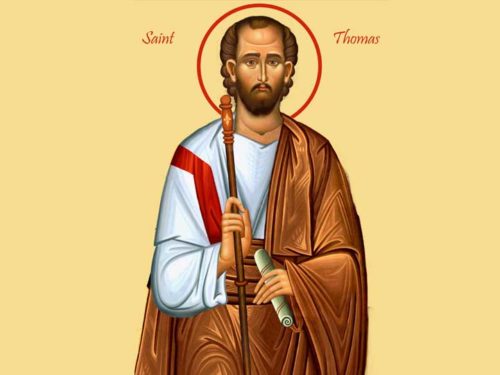
The Church traces its origins to St. Thomas the Apostle, who came to India in AD 52, established the Church and suffered martyrdom.
The head of the Indian Orthodox Church is the Catholicos of the East and Malankara Metropolitan whose seat is at Kottayam, Kerala, India. The Church has dioceses and churches in most parts of India as well as in the United States, Canada, United Kingdom, Western Europe, Persian Gulf nations, Malaysia, Singapore, Australia and New Zealand. The official title of the head of the Church is the “Catholicos of the East, Catholicos of the Apostolic throne of St. Thomas, and the Malankara Metropolitan”.
The Church, though modern in its vision and outlook, keeps the traditional Orthodox faith and liturgy. It accepts the first three Ecumenical Synods. The liturgy now in use is the translation of the liturgy adopted from the Antiochian Church in the 17th century. However, the liturgical rites are uniquely Indian.
The Indian Orthodox community inherited many aspects of Indian civilization and they are as any other member of any other community in India, in their customs, manners, and life style.
The Church has a Theological Seminary at Kottayam, Kerala, which was established in AD 1815. Another seminary is situated in Nagpur, Maharashtra. The later was established fairly recently in the later part of the 20th century.
The Church takes an active role in various ecumenical activities at national and international levels. It is a member of the World Council of Churches. Famous theologians such as Mar Paulose Gregorious, Mar Geevarghese Osthathios, Rev. Fr.V.C. Samuel, and Rev. Dr. K. M. George, who contributed to the negotiations between the Oriental and Byzantine churches, belong to this church. The Indian Orthodox Church also participated in the Ecumenical Council of Oriental Orthodox Churches held in Addis Ababa, in AD 1965.
Source: Northeast American Diocese website